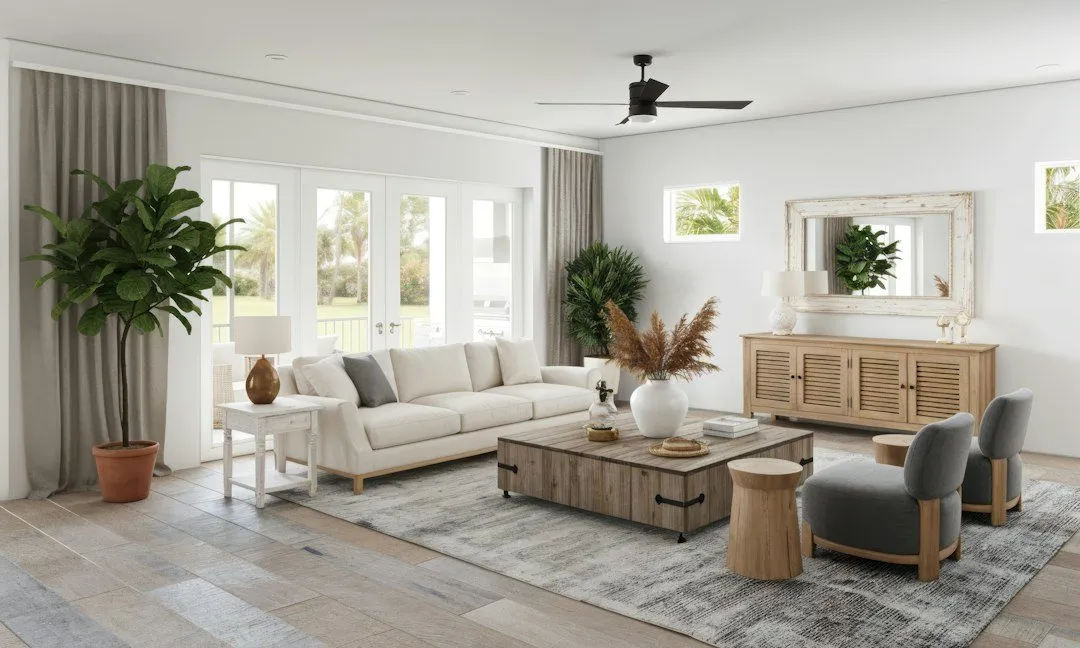
New construction interior design begins before the concrete is poured. The decisions that define a home are made in the first quarter of a project. By the time framing is complete, most of them are fixed.
Why timing is everything
A new build is not a renovation. In a renovation, the floor plan already exists. Walls are where they are. A designer works within the inherited structure.
In new construction, nothing is fixed yet. That openness is the opportunity. It is also where the cost of late engagement is highest.
A designer brought in during schematic design can shape the plan itself: where rooms sit relative to one another, how light enters, where indoor and outdoor thresholds align. These are structural decisions, not decorative ones. They close early.
Irvine interior design clients frequently approach the studio after a builder has already resolved the floor plan. The structural questions are answered. What remains is surface specification — and that is constrained by what the structure already allows.
The four phases and what each decides
Most residential new builds move through four phases: schematic design, design development, construction documents, and construction administration. Each phase closes a set of decisions.
Schematic design. Room placement, floor-to-floor relationships, and site orientation are established here. A designer’s role is to ensure the plan makes sense for how the house will actually be lived in — not just how it reads on paper.
Design development. The plan is resolved and material specification begins. Ceiling heights are confirmed, window configurations are set, kitchen and bath layouts are developed in detail. This is where new construction interior design becomes intensive. Early specification prevents costly substitutions later.
Construction documents. Drawings are produced for permit submission and trade coordination. Millwork drawings, tile layouts, and finish schedules are part of this package. A designer who cannot produce this level of documentation cannot fully serve a new build.
Construction administration. The build proceeds. The designer reviews submittals, answers requests for information, visits the site, and makes field decisions. This is where intent and execution can diverge without careful oversight.
What closes first
Three categories of decision are effectively fixed by the time framing is finished.
Structural openings. Window size, placement, and header height. Door openings and transitions between rooms. Once structural elements are in place, these cannot change without significant expense.
Rough plumbing and electrical. Fixture locations, outlet heights, and conduit runs are established during rough-in. Changes afterward require reopening walls.
Slab penetrations. Floor drains, hydronic systems, and any penetrations through the foundation are decided before concrete is poured. They cannot be revisited.
Material specification runs in parallel with these rough-in decisions. A designer who knows the floor finish before framing can ensure the structural floor sits at the right elevation. The specification cannot wait.
What a designer contributes across the scope
The value of Orange County interior design at the new-build level is not an end-of-project styling exercise. It is a sequence of decisions — each dependent on the one before — made in time to affect the outcome.
At schematic design, the studio evaluates the plan for livability, flow, and light. At design development, material and finish specifications are developed with trade coordination in mind. During construction administration, the studio is present as the build proceeds and intent is tested against reality.
That continuity — from initial plan through punch list — is what new construction requires. Disconnected phases tend to produce disconnected results.
When the studio can still help
Entering at design development, after the plan is set, is workable. The structural decisions have been made. Material specification, millwork design, and trade coordination are still open.
Entering during construction is a narrower engagement. What remains unspecified can still be addressed. The meaningful decisions, however, have already been made — by default rather than by design.
The earlier the conversation, the more the outcome is shaped by intent.
To understand what an engagement at your project’s current phase involves, see the studio’s new construction services.
To start a conversation, get in touch.