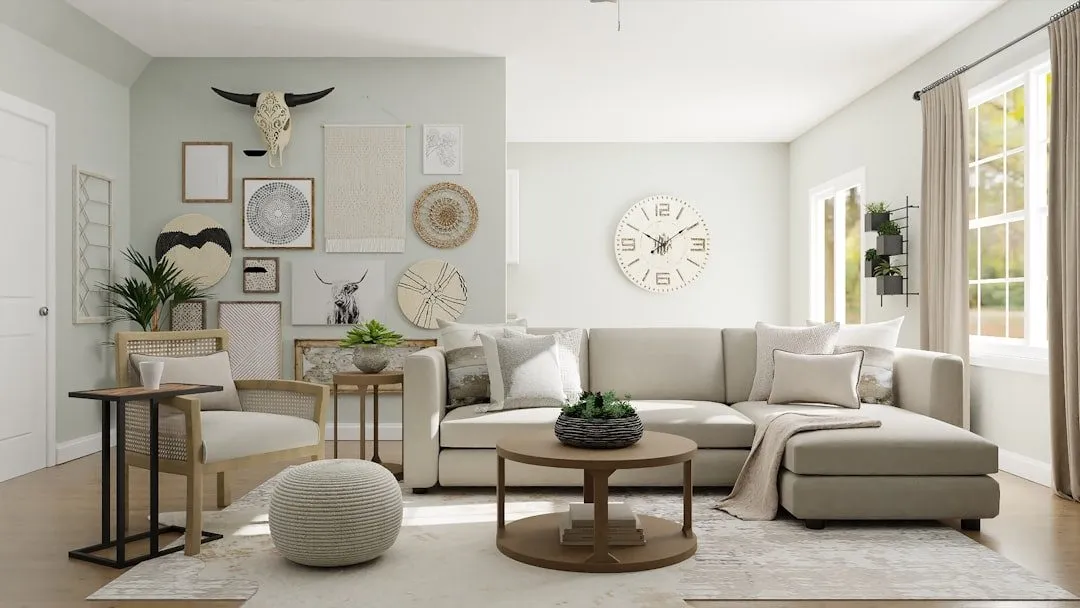
A well-considered coastal color palette is not a blue-and-white scheme. It is the subtler thing: warm, low-chroma tones that hold their character as the light moves through the day.
The challenge of coastal light
Southern California light is bright, reflected, and highly variable. What reads as soft at dawn can bleach out at midday and warm to amber at dusk. Most conventional coastal colors — ice blue, seafoam, chalky white — are designed to photograph well, not to live with year-round.
The tones that hold up are quieter. They sit in the in-between: not white, not grey, not linen, but something close to all three. On the Farrow & Ball range, colors like Wimborne White, Strong White, and Blackened shift with the hour — a quality that is a feature, not a flaw. The depth is in the compound undertone, not the saturation.
Start from what’s fixed
Color begins with material. Before touching a paint chip, establish the fixed elements: an existing stone floor, a threshold, the tone of cabinetry or millwork. These anchors set the key — warm or cool, raw or refined.
From that key, everything else pulls toward coherence. A warm travertine floor wants muted plaster, not a cooler white. White oak with a matte finish shifts the palette toward warm sand. A concrete threshold asks for something drier and more mineral. Working from the fixed material outward produces rooms with a quiet internal logic — a discipline that runs through modern coastal interior design as the studio approaches it. The studio uses a physical and digital mood board process to test these relationships before anything is committed.
The in-between tones
There are colors that don’t declare themselves. They fall somewhere between cream and stone, between linen and sage. In coastal rooms, these tones carry more weight than accent colors because they hold from morning to afternoon without going flat or hard.
Their strength comes from complexity — multiple undertones balanced so they read differently depending on the hour and the adjacent surface. That complexity is why they age better than a single bright color, and why rooms built around them feel calmer over years. Sample every candidate on the actual wall, in the room’s own light, for at least 48 hours. Avoid anything with too much white added — it will bleach in direct sun. Avoid high-saturation blues and greens, which become harder to live with over time.
Layering through material
A calm coastal room often works with two or three tones across the whole space. Depth comes from material variation, not palette expansion. A plaster wall and a painted wall can share the same color and read entirely differently because of surface texture.
Linen next to white oak, natural stone next to lime plaster, matte wood next to blackened steel — each pairing creates contrast without adding new hue. The depth is in the surface, not the color chip. This is how a room avoids feeling sparse while remaining quiet. The same thinking extends to window treatments for coastal light: linen panels add warmth and diffused texture without introducing a new color into the palette.
Restraint as method
The temptation near the water is to bring the outdoors in through color. But coastal homes already have views, reflected light, and the presence of landscape through glass. Adding more blue or more green tends to close a room rather than open it.
Restraint is the real strategy. One anchor material — a plaster fireplace surround, a large-format stone floor, a run of white oak cabinetry — gives the room its identity. Everything else recedes. Holding to that hierarchy without filling in is the quiet discipline behind Orange County interior design.
Before the final paint color
Paint is the last decision, not the first. Set the fixed materials, the flooring, and the natural light before touching a chip. Get large samples — at minimum A4, preferably A3 — and observe them at different times of day, including under evening interior lighting. What reads beautifully at noon can go flat or shift warm after dark.
If the palette still needs anchoring once paint is chosen, consider a plaster finish. The texture carries the color differently than any flat coat — more depth, more movement. As part of full-service interior design, the studio specifies and samples finishes at scale before anything goes to the wall.
Thinking through a coastal palette? Get in touch.