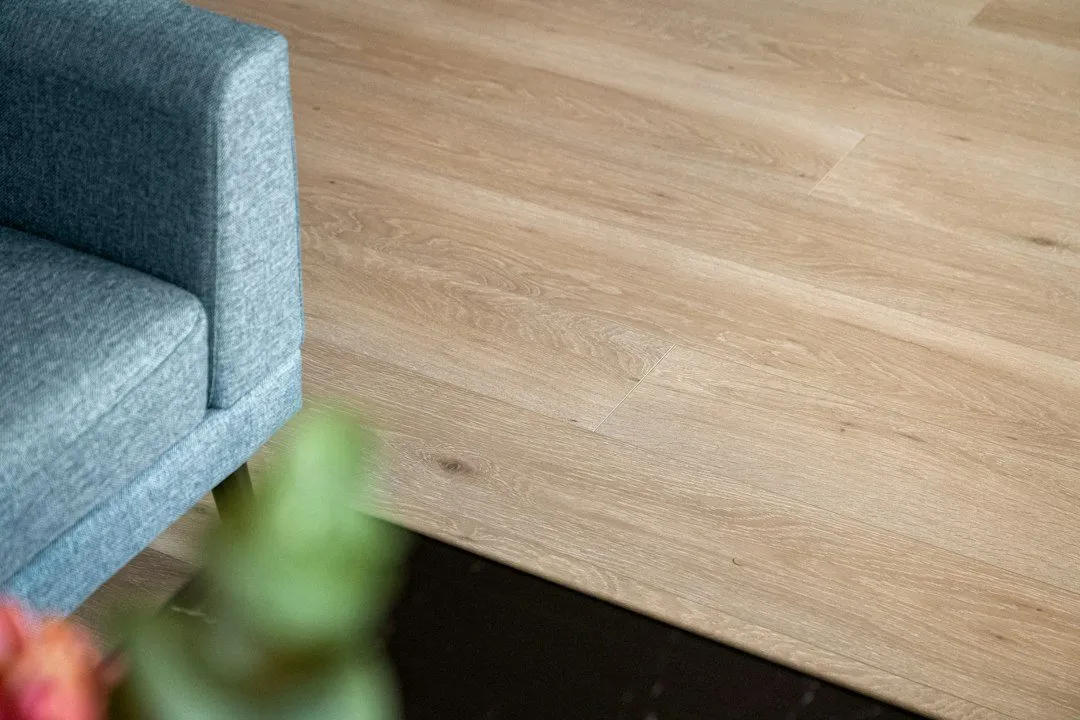
White oak flooring keeps appearing in good coastal houses for reasons that hold up over time. It isn’t trend-driven. The material earns its place through grain, tone, and behavior — three things that matter a great deal in a home that will be lived in for decades.
What makes white oak different
Among domestic hardwoods, white oak reads the most calmly. Its grain is straight and fine, with subtle ray fleck — a natural figure that adds interest without demanding attention. Tone-wise, it sits in a warm, cool-neutral middle register: not yellow like pine, not orange like red oak, not grey like concrete. That quality makes it easy to pair with the pale limestone, linen, and plaster finishes common in coastal California interiors.
In strong southern light, the wood doesn’t go garish. It settles into the room. That restraint is part of why the studio returns to it project after project in Orange County interior design.
How it’s milled: rift, quarter, and plain-sawn
The same species cut three different ways produces three different floors.
Plain-sawn is the most common and least expensive. The boards show wider grain variation and visible cathedraling — a more rustic character. Plain-sawn can work, but it reads louder.
Rift-sawn cuts the log at a consistent angle to the growth rings, producing tight, vertical grain lines across the board face. The result is calm, linear, and graphic. It handles stain and finish evenly.
Quarter-sawn is cut to maximize ray fleck — a silver-y, almost shimmering figure that runs across the face. It is dimensionally stable, which matters in humid coastal climates, and it has a quiet elegance that reads as more refined without trying.
For coastal homes where the palette is already understated, rift or quarter-sawn white oak carries the room without competing with it.
Finish matters as much as species
The finish is where many white oak floors go wrong. A high-sheen polyurethane coat makes any wood floor read as plastic — it reflects overhead light harshly, shows every scratch as a bright line, and dates quickly.
What works instead: hardwax oils, water-based low-sheen finishes, or wire brushing before finishing to open the grain slightly and give the wood a texture that holds light softly. Matte finishes read as closer to the material itself. Scratches and scuffs become part of the surface rather than evidence of failure.
Some projects call for white oak with a light lye-and-soap treatment to pull it toward pale silver. Done well, it reads less like a stained floor and more like a floor that has simply been there a long time.
How white oak ages
White oak is one of the few materials that improves with use. It lightens slightly over the first few years, then stabilizes into a silver-honey tone that is warmer than new and quieter than stained. Scratches and dents give it character rather than marking it as damaged. It is — genuinely — a material that looks better at twenty years than at two.
That matters in homes where the goal is a settled, considered interior rather than a room that needs refreshing every few years.
Why coastal homes in particular
In the studio’s project work — including the Stonegate Residence — white oak appears in living rooms, primary bedrooms, and in the transition zone between inside and exterior covered spaces. The material reads equally at home in a formal room and a casual one, and it accepts the same palette whether the stone underfoot outside is limestone or concrete.
It is also among the most stable wood species in humid climates. White oak has a tight, closed grain — less prone to cupping or gapping as humidity swings — which makes it the rational choice in coastal environments where conditions change with the season.
Specifying it well
Choosing the species is the first decision. The cut, the finish, and the installation method follow, each one affecting the result as much as the species itself.
Width matters too. Narrower boards (three to four inches) read more traditional. Wide planks (five to seven inches) show more face grain, suit larger rooms, and feel more contemporary. Most projects the studio specifies fall in the four-to-five-inch range — wide enough to read clearly without dominating.
Early specification is essential. White oak from domestic mills often requires lead time, and the finish process adds time on top. Projects that decide late sometimes end up with what’s available rather than what they chose.
This is the kind of decision — species, cut, finish, installation method — that defines a designer’s scope. If you’re wondering how a designer differs from a decorator, that question is answered in full.
The studio specifies flooring as part of interior architecture services — including selection, sourcing, mill coordination, and finish review.
Thinking through flooring for a project? Get in touch.