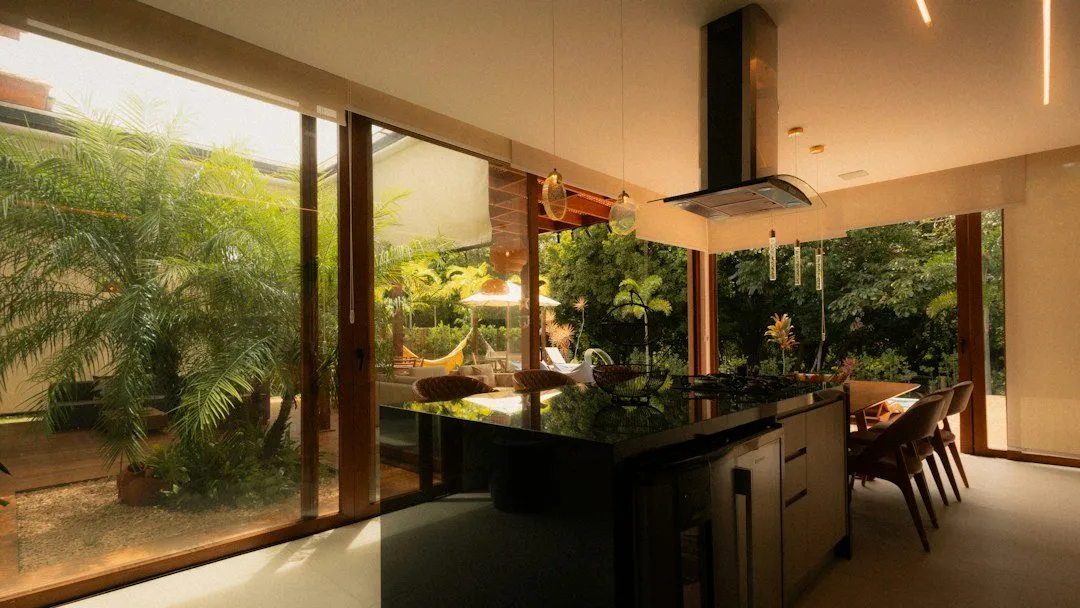
Coastal kitchen design, done well, has nothing to do with shiplap, rope pulls, or a backsplash announcing the sea. It is a kitchen that responds to the life and light of a coastal home — honest materials, considered proportion, and the right restraint. Here is how the studio approaches it.
The mistake to avoid
The themed coastal kitchen is a category of its own: weathered oak with lantern pendants, a tile backsplash in a nautical motif, hardware in an aggressively aged finish. It peaks early and dates reliably.
The quieter version does neither. It reads as coastal because it was designed for the coast — for the bright directional light, the salt air, the easy connection between inside and out — not because it signals it.
Layout and proportion
The kitchen’s proportion matters more than its finish. A good coastal kitchen is legible: clear sightlines from the work area toward wherever the light comes in, a sequence that doesn’t cross itself, a physical relationship with the rest of the living space.
That last point is particular to coastal homes. The kitchen rarely exists in isolation here. It opens to a dining room, a terrace, or a view. Planning the layout with that relationship as the brief — rather than optimising the kitchen in isolation — is what gives it ease. This is the same logic that runs through modern coastal interior design more broadly: the threshold between inside and out shapes everything that touches it.
Material is the design move
In a coastal kitchen, the surface choices establish the character of the room before a single fixture or hardware choice is specified. Countertop, flooring, cabinetry face, backsplash — together they set the material register the kitchen will live in.
The studio reaches for materials that age honestly in a coastal environment. Natural stone countertops — honed quartzite or a matte limestone — hold up to bright overhead light without the reflective harshness of polished surfaces. They also develop a patina, which is the point. A surface that looks better in five years is worth more than one that looks worse.
Cabinetry in a painted finish or a natural wood veneer — European white oak is a considered choice that reads well against coastal light — gives the room warmth without weight. Where open shelving replaces some closed cabinetry, the studio approaches styling it with the same material restraint: fewer objects, honest materials, negative space. The floor follows the same logic as elsewhere in the house: the same material or a close relative, so the kitchen doesn’t announce itself as a separate room.
Light management
Coastal kitchens sit in strong, directional light. That is the gift — and the challenge. Finishes that appear right in a showroom can feel harsh at noon. The studio evaluates surface choices against the actual light conditions of the site: the orientation of the room, the height of the window, how light moves across horizontal and vertical planes through the day.
Matte and honed surfaces absorb rather than reflect. A limewashed or plastered splashback or range-hood surround — in a kitchen not exposed to heavy steam — softens the quality of light in a way that paint does not. Where tile is specified, an unglazed or low-sheen surface in a warm neutral reads more quietly than a glossy white, whatever the light.
Window placement is part of this. A well-positioned window over the sink creates ambient fill and a view rather than a source of midday glare.
Hardware as a finishing argument
Hardware in a coastal kitchen follows the material logic of the rest of the house. Uncoated or unlacquered metals — brass, bronze, dark nickel — that will patina are a considered choice. Polished chrome in a kitchen working toward warmth rarely helps it get there.
The details are where the kitchen reveals its quality: whether the drawer profiles have weight, whether the pulls are properly scaled to the door, whether the hinges are concealed or expressed as a designed element. These are architectural decisions. They sit within the scope of interior architecture rather than decoration — the point where material thinking meets the structure of the room.
The kitchen as part of the house
A kitchen that works in a coastal home works because it was designed as part of it. Palette, material, and proportion read across rooms. The kitchen has the same character as the living space — the same floor, the same restraint, the same understanding of the light. That coherence is what distinguishes a well-considered coastal home from a series of separately designed coastal rooms.
It is the approach the studio takes across Orange County interior design projects: consistency of material and palette from room to room, no room deciding its own aesthetic in isolation.
Starting a kitchen or a whole-home project? Get in touch.